Wednesday, 5 September 2007

Nearly there


I have had a few weeks off in August for holidays etc so progress should have been rather slow. Fortunately, the kids also took a week out to visit their Grandmother.... So progress has sped up!
The two tanks are now connected and the filters are in place too (with their own pump).


The main tank has its heating element fitted just above the start of the cone. Its a simple immersion heater with built in thermostat. The two tanks both have a site tube running down th eside to see how full they are. The same hose type is also used to link the tanks to allow them to breath. Lastly, the breather pipe vents to the outside to prevent fumes building up inside the building.
The second tank is for settling the processed mixture. The mixture of Bio and Glycerin and left over Methoxide will be pumped over and left to settle. Once the glycerin has been drained off, the remaining Bio (with some leftover Glycerin and reactants) is then pumped through the filters. They filter at 20, 10 and 5 microns. The last filter is a 1 Micron absolute filter.


In the foreground yo can see the input filter (Blue and white). This is where the first pump sucks in raw oil. If the oil has been used, it will need filtering, hence the 250 micron filter.

I've mounted the controls for the pumps and heater in this panel here: there's one switch each for the two pumps and the heater. The display on the right is a PID. It monitors a temperature and can turn another device on or off depending on the temperature I set.


Friday, 3 August 2007

Its green Jim....

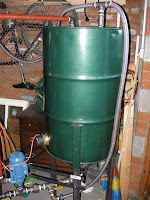
Since the last post I have been painting and making pipes. I have painted the drums in a mid green chemical and rust proof pant by Hammerite. It has the traditional hammered finish but makes the drums look considerable smarter (even though I do say so myself).
I have also been busy forming the pipe work on the main processor tank. The red pipes have had to be cut by hand (hacksaw) and then threaded with a hand ratchet threader. This is very tedious but much cheaper than a powered device. It takes about 35 mins to cut and thread (both ends) of a section of pipe. Fortunately, they all fitted, though I was worried with one joint where it looked like the section would be a tad too short! (dodged a bullet though by tightening some other joints to reduce the last 1/8 inch).

The pipe work is made from black iron pipe as used in (natural) gas systems (and according to the supplier on airport fuel systems too). Its therefore quite heavy! Hence the small trolley jack in the bottom of the picture holding up the now rather off balance processor tank. The biggest weight is the blue pump mounted vertically to the side of the tank. In an ideal world it would have been tight to the tank but the plumbing it connects to at the base was just too long. Most of the parts are off the shelf so I have just had to deal = longer connectors etc.

This image shows the piping from the base of the tank to the base of the pump. Its an important section; it has a valve (ie a tap to empty/seal the tank), a spur for the sight tube (to see how full the tank is), a branch to the pump inlet and a branch with valve to the outside world for draining as needed. This is why its so long. (ooer!)


Once through the pump, the mixture rises vertically and then either goes back into the processor for recirculation (and further processing/mixing) or if the valve (in the above pic) is shut, it diverts into the other tank for settling prior to filtering.
Back into the top:

The next bit in the build is to plumb the settling tank. I've started but as yet I'm not certain about the links between these bits and the rest..... !?!
TBC

Wednesday, 18 July 2007

The dums are back.

The drums have been away for welding over the last week or so (the welder was away mid way hence the time it took..) He has welded along the seam and around the edge of the drums to attach the cones to what will become th ebottom of the tanks:
On the top (bottom of the tank) there is a threaded pipe fitting t allowe the pipe work to attach. This too is welded in place.

Lastly, I the welder has attacjed three box sections of steel to the sides of the tanks. Into these go the support legs to raise the tanks off the ground. Once in place the taks stand a little under 6 feet tall.


Thursday, 12 July 2007

Link - The Sun, New York - BioDiesel for removal trucks

A large removals firm in New York city is due to pilot BioDiesel on 10% of their trucks (around 50 vehicles). The equivalent saving on CO2 emissions of 45 vehicles per year!

If you want to buy BioDiesel in the UK, check out this map to find your local source.

Monday, 9 July 2007

Drum Fabrications

Its been a while since I last posted... I've had the drums in the garage for about 6 weeks or so and they've just sat there! They couldn't even be bothered to keep the cobwebs off themselves!

Anyway, I cut the bottoms out and set about getting the cones made to attach to then (the drums need a need a cone shaped bottom to aid drainage). and hit a brick wall. The plans I have call for a cone fabricated from 16 or 18 gauge mild steel. Its made by cutting out a circular piece of steel with about 25% of the circle missing.

Once cut out, the two edges are joined and voila: one cone! (repeat for drum No 2).


Everyone I called or went to see could do the cut out but not the bending to shape. No one seemed to have the right tools or if they had the tools, they weren't the right size etc etc etc....


In the end I had the metal pressed out flat and did the bending at home, with my work bench and some left over metal bars.

Here it is (shaped but not welded):

Friday, 20 April 2007

PPC - Pollution Prevention Control (Permit)

Forgive me Bloggers, its been a few weeks since my last blog...


Part of the plan to make bioDiesel includes a "is this a business?" aspect. Living in the UK (and therefore the EU) there is a rather a lot of red tape to negotiate, particularly if there's chemical, big business and cars involved!

If we make more than 5 tonnes or about 5000 litres of BD per year, or sell any of it to the public, then I am deemed to be "Commercial" and so need regulating.

I have looked around the web and chat forums for info on the whole regulation thing and read some scare stories about consultants costing 10s of thousands needed to obtain said permits and also of the hoops to jump through if you DIY. By this time I'm getting a bit concerned so I called the Environment agency (who issue the permits) ad spoke to a very helpful chap in the local office. The long and short of it is that there are 2 types of permit, roughly based on if you dispose of by products by land fill/incineration or by other (environmentally friendly) means. His experience suggests most BD producers should be in the second group of "Low impact" permits.

Further, and this is the best bit, he advised they EA expects to offer around 15 hours of his time (he's the one who issues the permit) to assist with the forms/application process etc, free of charge. The only likely consultant costs would be the site survey (a benchmark of current site pollution/status etc).

All you have to do is ask!

Wednesday, 21 March 2007

Benchmark MPG update

Latest fill up:
17/3/07, 63.88 liters, 469 miles, 34.8 MPG avg, 30.8 MPH avg, 91.9p/liter, 12.5p/mile


Historical
12/3/07, 67.84 litres, 488 miles, 33.6 MPG avg, 26.1 MPH avg, 89.9p/litre, 12.5p/mile
5/3/07, 64.92 litres, 434 miles, 31.3 MPG avg, 22 MPH avg, 89.9p/litre, 13.4p/mile